
After work on Super Mario Galaxy, Nintendo EAD Tokyo colleagues Yoshiaki Koizumi and Hideaki Shimizu tried a small drawing experiment. Shimizu initially sent DS touchscreen pictures to a Wii display. Koizumi proposed turning the drawings into flipbook animation; the prototype later gained microphone-recorded sounds. They showed it internally as “Flipnote Workshop” in April 2008. Koizumi then suggested a portable notepad identity and the Japanese name Ugoku Memochou, shortened to Ugomemo. These are accounts from historical interviews, not conclusions derived from ROM bytes. [1]
Local DS sharing was considered, followed by a plan in which the Wii would distribute the application through Download Play and provide an online route for creations. Once the pair learned of the DSi, its built-in download and network facilities offered a better fit. Takashi Tezuka arranged a discussion with Satoru Iwata; Iwata suggested Hatena when Nintendo's own network group appeared unable to deliver the online service within the desired schedule. At the Hatena meeting, Koizumi demonstrated the working application after a presentation problem. The wiki attributes the first service work to a three-person Hatena team led by Teppei Ninomiya. [1]
| Date | Milestone |
|---|---|
| Autumn 2008 | Hatena begins its service work with a small team. |
| 18 December 2008 | Nintendo and Hatena announce the project and demonstrate creating and uploading a Flipnote. A preview website appears the same day. |
| 24 December 2008 | The Japanese DSiWare release arrives. |
| 27 April 2009 | Japan receives version 2 with advanced tools, more sample notes, SD backup, online changes and a revised DSi Menu icon. Version 2 becomes necessary for Hatena access from 1 July. |
| 29 July 2009 | Japan's version 2.1 improves network communication and Hatena ID registration. |
| 12–14 August 2009 | Western regional releases begin. |
| 31 May 2013 | The original Flipnote Hatena service closes after a period of slowing development. The wiki's more precise account of the internal decision is explicitly tentative. |
| 24 July 2013 | Flipnote Studio 3D launches in Japan. |
| 26 January 2014 | PBSDS publishes hatena-server, an early public replacement implementation. |
| 29 January 2014 | Sudomemo launches. |
| 26 January 2018 | The wiki records failure of the remaining Hatena authentication endpoint after internal service changes; it does not establish that this was intentional. |
| 2 April 2018 | Flipnote Gallery World closes. |
The announcement included a live creation and upload demonstration and a preview of the desktop website. Hatena planned to fund the service through advertising and possible premium features. Studio, the online service and the website were developed by different organisations and have partly separate histories. Later authentication changes also affected access to fan servers. The wiki's patching-status notes date from 2018; use a maintained guide for present-day setup. [1][3]
Research contributors
The wiki credits bricklife and mirai-iro for early PPM work, steven and yellows8 for extending that documentation, JSA for pre-closure traffic captures, and PBSDS for file-format and web-client investigation and Hatena-tools. It identifies Nick Swarr with UGO work; Midmad and WDLMaster with sound-codec research; and Sudofox with browser features. Jaames is credited with documentation and additional UGO, image, PPM, keyboard, search and metadata work. It also records Shutterbug2000's internal and exploit research, Khangaroo's PPM audio-alignment findings, PokeAcer's authentication captures, and GBATEK as a DSi hardware reference. Credit these contributors when relying on their original findings, and distinguish their reverse engineering from Nintendo and Hatena's product development. [2]
How the project changed before release
Work began after Super Mario Galaxy was finished in late 2007, in Nintendo EAD Tokyo's Software Development Group No. 2. Hideaki Shimizu wanted to make a networked application. His DS-to-Wii drawing demonstration came before he and Koizumi knew about the DSi. After Koizumi suggested flipbooks, they made an animation prototype in roughly two days and added microphone sound effects during the same period of experiments. [1]
The April 2008 internal demonstration met some scepticism: one programmer questioned whether people would want to make flipbooks on a console. Later, while travelling by train, Koizumi considered the more everyday use of a notepad, leading to the Ugoku Memochou name. Local DS wireless sharing seemed too limited. One intermediate plan used WiiWare to distribute the DS editor through Download Play, receive its creations on Wii and publish them on an internet bulletin board. The released DSiWare application followed a different design. [1]
- DS sketches sent to a Wii display
- Animation and microphone experiments
- WiiWare plus DS Download Play proposal
- DSiWare editor paired with Hatena's online service
Tezuka wanted the project to reach users soon and brought it to Iwata, then Nintendo's chief executive. Nintendo's network-development staff were busy, raising concerns that the service would not be ready until late-2009. Iwata suggested Hatena, whose research group had recently moved to Kyoto near Nintendo. A presentation problem at Koizumi's meeting with Junya Kondo and Teppei Ninomiya led him to demonstrate the working application instead. The wiki notes that this suited Hatena's own approach. [1]
The 2008 announcement and its surviving records
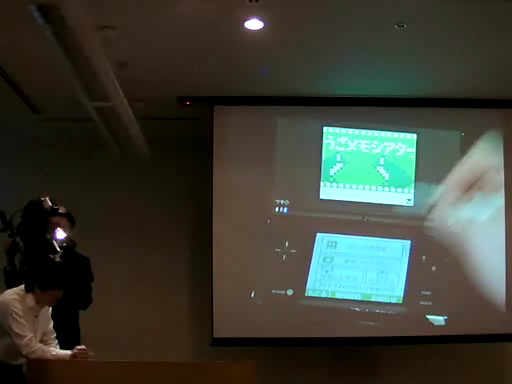
Hatena started service development with three people led by Ninomiya. About three months later, the project was announced on 18 December 2008 at the Marunouchi Building Conference Square. Kondo introduced Hatena and the service, and Koizumi introduced Studio and a promotional film. They then demonstrated creating and uploading a note, and Kondo showed the desktop website. According to the account, Hatena took no development payment from Nintendo. It saw the project as a way to introduce its wider services, funded through advertising and premium features. These details concern the original partnership, not current fan-service finances. [1]
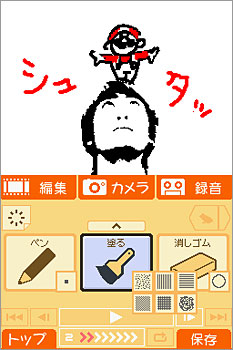
The preview website went live on announcement day, mostly showing notes by Nintendo and Hatena staff. The records below include an early screenshot, a public demonstration, advertising, the preview site and a later anniversary account of the western launch. They document what was shown at different times; a photograph alone cannot date an executable build. [1]
| Record | Historical relevance | Link |
|---|---|---|
| Autumn 2008 Nintendo demonstration | The wiki identifies this as the earliest known screenshot of the prototype. | Conference screenshot |
| 18 December announcement | Contemporary reporting with photographs of Koizumi presenting and Kondo demonstrating the DSi service. | gihyo.jp report; Koizumi presenting; Kondo's DSi demonstration; ITmedia report |
| Announcement-day website preview | An archived early version of the Japanese service. | 21 December archive snapshot |
| Shinjuku Station advertising | A photograph described in the wiki as taken on 25 December, the day after Japan's release. | Historical advertising photograph |
| Western service launch | A photograph from Hatena's Kyoto office, described as showing the moment the service opened; the associated anniversary article is dated 13 August 2010. | Office photograph; Anniversary article |



Closure dates and unresolved details
The wiki reports declining activity after the 3DS launched in 2011, a smaller Hatena team and staff moving to other projects. Its suggestion that an internal closure decision was made around April 2013 is uncertain. The public announcement is clearer: Hatena's page is dated 14 March 2013 and gives the closure date as 31 May 2013. The compiled wiki says 14 May but links to that March article, which resolves the publication-date discrepancy. The announcement also says Studio remains usable offline after online sharing closes. [1][4]
Developer Eitaro Fukamachi, nitro_idiot, joined the team in 2011. The wiki links his personal reflection on the ending, in which he felt the service's history would outlast its closure, and his 2 June 2013 blog post. The latter includes a photograph taken around the closure, showing Fukamachi on the left, designer chira_rhythm55 in the centre and director takapiero on the right. These are accounts of the staff's experience, rather than independent measurements of service traffic. [1]

The wiki credits PBSDS's 26 January 2014 repository release as the first public fan replacement; that does not rule out earlier private or experimental work. It separately dates Sudomemo's launch to 29 January 2014, the loss of the remaining Hatena authentication endpoint to January 2018, and the 3DS gallery's closure to 2 April 2018. The exact authentication date is unresolved: the patching page gives 17 January with a question mark, while History gives 26 January. [1][3]
The source leaves details of western releases, seasonal events and shutdown activities unfinished. It names Usomemo/Foolipnote and Zelda events as future topics without giving dates or a complete list of events. See research credits and sources for the people and tools behind the format research. [1]
People and original accounts
The development account draws on Iwata Asks, volume 7 and the contemporary reports above. It also links biographical and organisational pages for Yoshiaki Koizumi, Hideaki Shimizu, Takashi Tezuka, Satoru Iwata, Hatena, Junya Kondo and Teppei Ninomiya. Use these for background; refer to the interview for specific claims about development. [1]